
News
11/11/2025
Rural Development and Art Deco: The Budapest Headquarters of the Hangya Cooperative
It may come as a surprise, but the Hangya Cooperative, which played a key role in the development of the Hungarian countryside, once had its Budapest headquarters built in the Art Deco style — a true masterpiece of modernist architecture.
In the early 20th century, as Hangya became one of Hungary’s most influential cooperatives, it established its headquarters in Budapest, then a rapidly growing and modernizing metropolis, near Boráros Square. The complex consisted of three riverfront buildings:
- on the corner, a still-standing four-storey residential building (Közraktár Street 34), whose ground floor once housed Hangya shops;
- a three-storey department store with a decorated façade (Közraktár Street 32), which was unfortunately demolished in 2006;
- and finally, the Hangya Cooperative Headquarters (Közraktár Street 30), still regarded today as one of the finest examples of Budapest’s Art Deco architecture.
Built in the early 1920s, the headquarters was designed by Dénes Györgyi, while the eight reliefs adorning its modern, streamlined façade were created by Lajos Mátrai Jr. and Béla Ohmann.
The project Memoria Națiunilor (Memory of Nations) is being implemented under the INTERREG VI-A Romania–Hungary Programme, with the support of the European Union through the European Regional Development Fund, and co-financed by Romania and Hungary.
05/11/2025
The buildings of the Hangya Cooperative in Oradea between the two World Wars
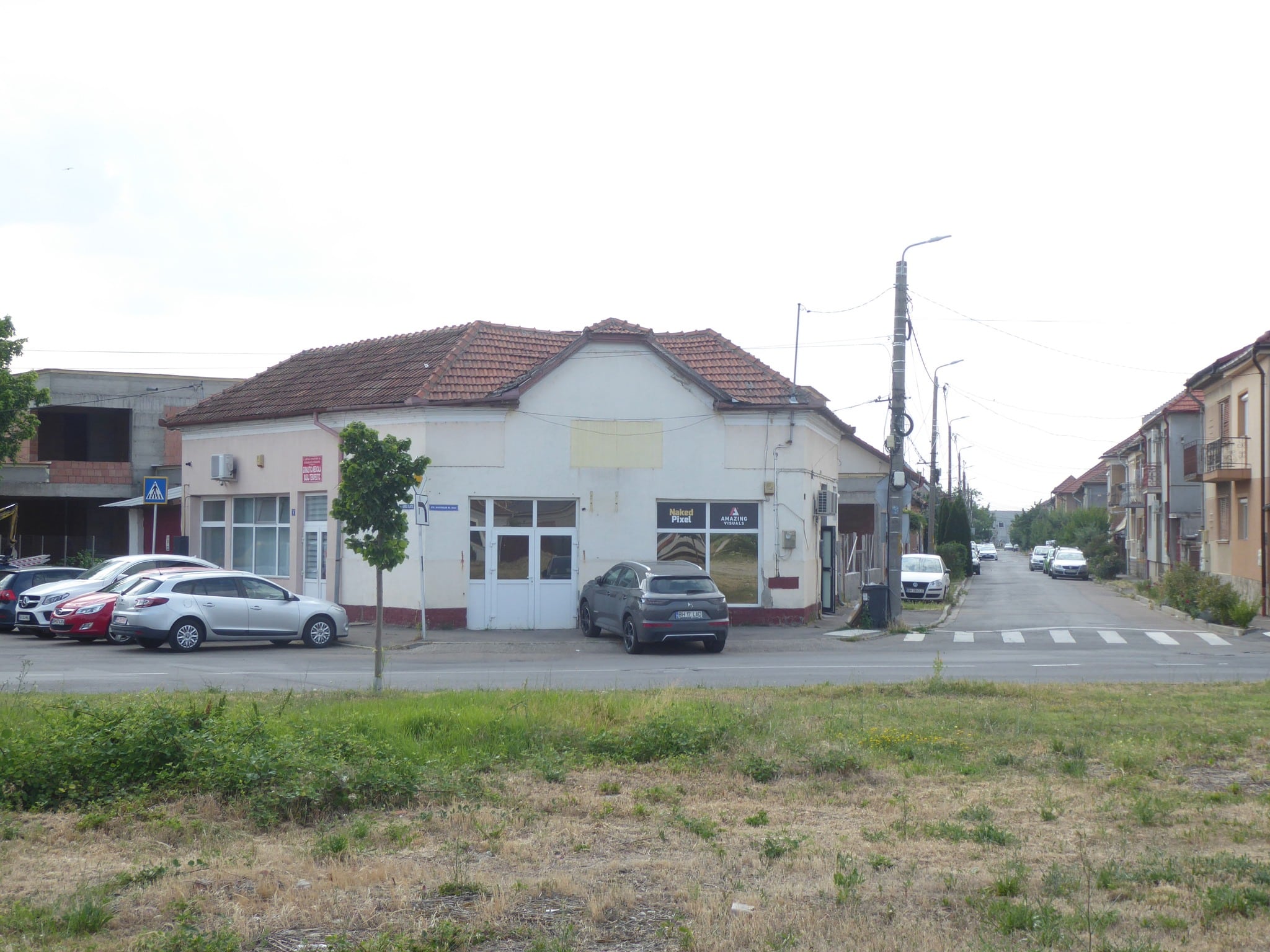
After World War I, the Transylvanian Hangya Cooperative, then in a state of recovery, opened its first branch office in Oradea, on Körös Street, next to the Lutheran church. From there, it supplied small shops in the regions of Țara Călatei, Țara Ierului / Valea Ierului, Satu Mare, and Maramureș. If you have any photos or memories of this building, please share them with us!
Thanks to growing sales, Hangya was able to build its own premises in 1938. They acquired a plot of land in the rural suburb of Ioșia (Ősi). Dénes Győrfi describes the building at 1 Aurel Vlaicu Street as follows:
“One side of the property facing the two streets is 42 meters long, the other is 34 meters. There was a separate entrance on both streets for arriving and departing cooperative members. The building had two offices and four storage rooms: for haberdashery, spices, bottled drinks, and confectionery. The iron department, along with oil, paint, and soda products, was located in the bright basement. The entire attic was filled with glassware. In the courtyard, there were apartments for the manager and janitor, as well as a separate, triple-division shed for trucks, salt storage, brooms, iron bars, and packing crates.”
(Source: https://adatbank.ro/html/alcim_pdf2618.pdf)
Have any old photos or memories of the building? Please share them with us!
The project Memoria Națiunilor (Memory of Nations) is being implemented under the INTERREG VI-A Romania–Hungary Programme, with the support of the European Union through the European Regional Development Fund, and co-financed by Romania and Hungary.
03/11/2025
In the Footsteps of the Lost Mill
Amid Oradea’s new residential parks, some landmarks from the past still stand tall. One of them is the old factory built around the turn of the century as the Szent László mill — its windows are still clearly visible today.
Many long-time residents know the building at 11 Sánc Street as the May 1st fur factory, which also served as a Hangya Cooperative warehouse in the 1940s.
Hangya had warehouses in many other towns too — including Arad, Baraolt, Miercurea Ciuc, Dej, Cluj-Napoca, Târgu Secuiesc, Târgu Mureș, Aiud, Sfântu Gheorghe, Satu Mare, Cristuru Secuiesc, Odorheiu Secuiesc, and Șimleu Silvaniei.
We’re collecting photos, stories, and memories for our research and education projects — whether connected to the Oradea warehouse or any of the others. If you have something to share, we’d love to hear from you!
The project Memoria Națiunilor (Memory of Nations) is being implemented under the INTERREG VI-A Romania–Hungary Programme, with the support of the European Union through the European Regional Development Fund, and co-financed by Romania and Hungary.
